Introduction: The Problem Isn’t That You Lack Discipline
You tell yourself you’ll stop scrolling.
You’ll stop checking your phone every five minutes.
You’ll stop reaching for sugar when you’re stressed.
You’ll stop procrastinating on the thing you actually care about.
And yet somehow, you find yourself doing it again.
Not because you’re lazy.
Not because you don’t want change badly enough.
But because your brain is operating exactly as it was designed to.
Understanding dopamine loops changes the conversation entirely. What feels like a personal failure is often a neurological pattern running beneath conscious awareness.
The habits that frustrate you most aren’t random. They’re usually connected to rewards, anticipation, emotional regulation, and the brain’s deep desire to seek pleasure while avoiding discomfort.
The moment you understand how dopamine loops work, you stop fighting yourself and start working with your brain.

What Are Dopamine Loops?
A dopamine loop is a cycle that reinforces behavior through anticipation and reward.
Most people think dopamine is the brain’s “pleasure chemical.”
That’s only partly true.
Research shows dopamine is heavily involved in motivation, learning, reward prediction, and habit formation. In many cases, dopamine spikes before the reward arrives, not after.
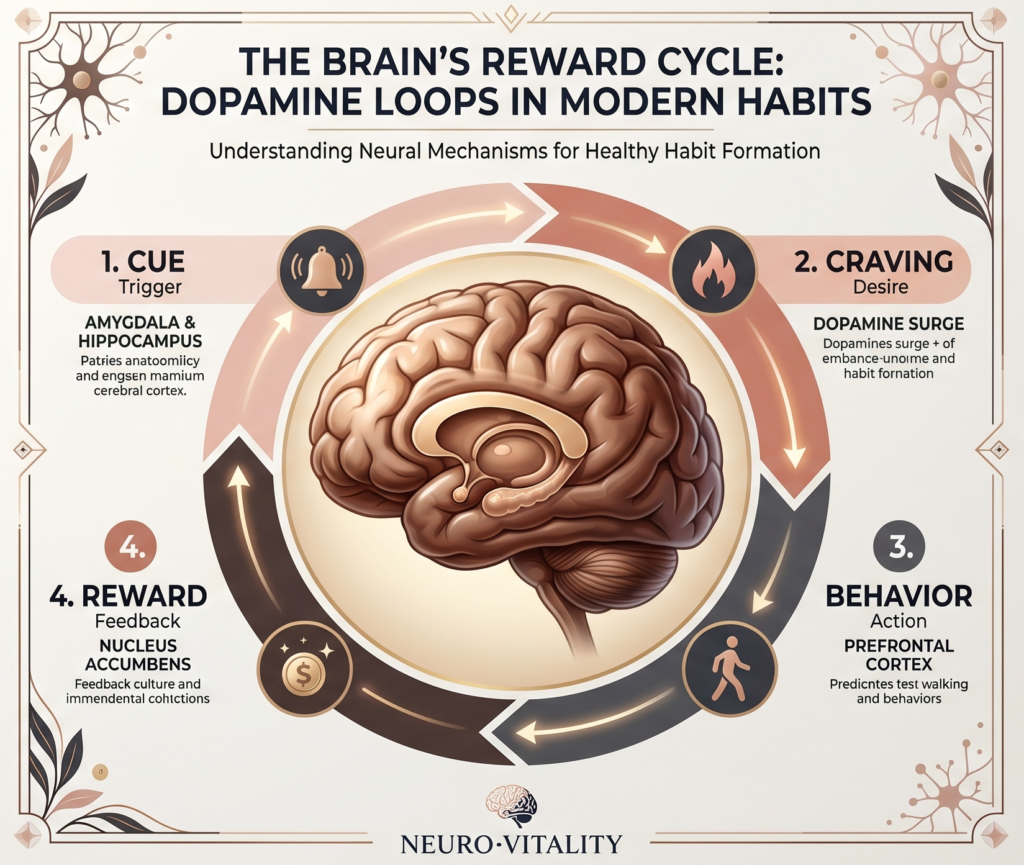
Your brain learns:
Cue → Craving → Behavior → Reward
Then it stores that sequence for future use.
The more often the cycle repeats, the stronger the neural pathway becomes.
For example:
- You feel stressed.
- You open social media.
- You get novelty, distraction, or validation.
- Your brain registers relief.
- The habit strengthens.
Over time, the cue alone can trigger the craving.
You don’t consciously decide to check your phone.
Your brain already started the process.
That’s the power of dopamine loops.
Why Bad Habits Feel Better Than Good Habits
One of the most frustrating realities of personal growth is that unhealthy behaviors often provide immediate rewards.
Healthy behaviors often provide delayed rewards.
Your brain naturally prefers immediate certainty.
Consider the difference:
| Behavior | Reward Timing |
|---|---|
| Eating junk food | Immediate |
| Scrolling social media | Immediate |
| Online shopping | Immediate |
| Exercise | Delayed |
| Building a business | Delayed |
| Saving money | Delayed |
| Learning a skill | Delayed |
The brain isn’t asking:
“What’s best for me next year?”
It’s asking:
“What helps me feel better right now?”
This is why dopamine loops become so powerful.
They offer quick relief.
And relief is incredibly reinforcing.
The Hidden Role of Emotional Regulation
Most conversations about habits focus on behavior.
Few focus on emotion.
But many dopamine loops aren’t actually about pleasure.
They’re about avoiding discomfort.
You might think you’re addicted to:
- Scrolling
- Snacking
- Shopping
- Netflix
- Gaming
- Checking notifications
But often you’re seeking relief from:
- Boredom
- Anxiety
- Uncertainty
- Loneliness
- Rejection
- Stress
The habit becomes a nervous system strategy.
A way to shift emotional state quickly.
This is where many self-improvement approaches fall short.
They try to eliminate the habit without addressing the emotional need underneath it.
The behavior disappears temporarily.
The discomfort remains.
Eventually, the habit returns.
How Dopamine Loops Rewire Identity
The longer a dopamine loop runs, the more it starts influencing how you see yourself.
You stop saying:
“I sometimes procrastinate.”
And start saying:
“I’m a procrastinator.”
You stop saying:
“I struggle with consistency.”
And start saying:
“I’m just not disciplined.”
Identity forms around repeated behavior.
This creates a second loop:
Behavior → Evidence → Identity → More Behavior
Now you’re not only fighting the habit.
You’re fighting the story you’ve built around it.
This is why breaking a dopamine loop often feels surprisingly emotional.
You’re not just changing actions.
You’re updating self-perception.
And identity shifts can feel uncomfortable, even when they’re positive.
Why Willpower Usually Fails
Willpower works best in short bursts.
Habits operate all day long.
That’s a mismatch.
Imagine relying on motivation every time you:
- Walk past your phone
- Open your laptop
- Feel stressed
- Get bored
- Face uncertainty
Eventually, decision fatigue wins.
This isn’t weakness.
It’s cognitive overload.
The most effective habit changes happen when you redesign the environment instead of constantly battling temptation.
Examples:
- Remove distracting apps from your home screen.
- Keep unhealthy snacks out of immediate reach.
- Create friction around unwanted behaviors.
- Reduce decisions whenever possible.
Good systems outperform strong intentions.
Every time.
A Better Way to Break Dopamine Loops
Breaking dopamine loops isn’t about deprivation.
It’s about replacement.
The brain doesn’t like empty space.
When you remove a habit, you need a new response available.
Instead of:
Stress → Social Media
Try:
Stress → Five-minute walk
Instead of:
Boredom → Phone
Try:
Boredom → Reading one page
Instead of:
Anxiety → Snacking
Try:
Anxiety → Deep breathing or journaling
The goal isn’t perfection.
The goal is teaching your brain a new pathway.
Small repetitions matter more than dramatic transformations.
Pay attention to one behavior today that happens almost automatically.
Ask yourself:
What feeling comes right before it?
That answer often reveals more than the habit itself.
Awareness is the beginning of rewiring.
Not judgment.
Not shame.
Awareness.
The Future of Habit Change: Working With Your Brain
The most successful habit changes happen when people stop viewing themselves as broken.
Human behavior follows patterns.
Patterns can be understood.
And what can be understood can be changed.
The conversation around dopamine loops isn’t really about avoiding pleasure.
It’s about becoming conscious of where you’re seeking it.
Some rewards create freedom.
Others create dependence.
The question isn’t whether you’ll live through dopamine loops.
You already do.
The question is whether those loops are building the life you want – or quietly pulling you away from it.
Frequently Asked Questions About Dopamine Loops
What is a dopamine loop?
A dopamine loop is a repeated cycle where a cue triggers a craving, leading to a behavior that produces a reward. Over time, the brain strengthens this pattern, making the behavior increasingly automatic.
Are dopamine loops the same as addiction?
Not necessarily. Dopamine loops exist in everyday habits and routines. Addiction involves more complex neurological, psychological, and behavioral factors, though dopamine plays a role in both.
Why do bad habits feel rewarding?
Many bad habits provide immediate gratification or emotional relief. The brain tends to prioritize immediate rewards over long-term benefits, making these habits highly reinforcing.
Can dopamine loops be changed?
Yes. Through awareness, environmental design, habit replacement, and repetition, new neural pathways can form that weaken old dopamine loops and strengthen healthier behaviors.
Is dopamine harmful?
No. Dopamine is essential for motivation, learning, movement, and goal pursuit. The challenge isn’t dopamine itself – it’s becoming trapped in unhealthy reward cycles.
How long does it take to break a dopamine loop?
There is no universal timeline. Factors like habit strength, environment, emotional triggers, and consistency all influence how quickly new patterns become established.
Conclusion: The Real Goal Isn’t More Discipline
When people talk about changing their lives, they often focus on becoming more disciplined.
But discipline isn’t always the missing piece.
Sometimes the missing piece is understanding.
Understanding why you reach for the thing you reach for.
Understanding the emotional need beneath the behavior.
Understanding how dopamine loops quietly shape daily decisions.
Because once you see the loop, you’re no longer trapped inside it unconsciously.
And that changes everything.
The goal isn’t to become someone who never seeks pleasure.
The goal is to build dopamine loops that support the person you’re becoming.
If you’ve identified a dopamine loop that’s keeping you stuck, don’t start by trying to eliminate it overnight.
Start by observing it.
Track the cue.
Notice the emotion.
Create one small alternative response.
Transformation rarely begins with force.
More often, it begins with awareness repeated long enough to become a new identity.
Read More:
How Your Brain Builds Your Identity (And Why It Feels So Hard to Change)
Wealth Identity Frequency Explained: Why You Can’t Outgrow the Identity You Haven’t Rewired
What Is Subconscious Identity Work & Why It Matters (If You’re Done Starting Over)
How Subconscious Patterns Control Your Behavior Guide 2026
How Brain Rewiring Actually Works (Neuroscience Explained)
Expand Wealth Capacity Without Fear: The Nervous System Shift That Changes Everything
The Invisible Cost of Success Without Boundaries
Signs You’re Still Running on Survival Energy (Even If You’re Successful)
Why You’re Not Stuck: How Subconscious Identity Work Unlocks Success & Wealth
Why High-Achieving Women Feel Capped — And How Subconscious Identity Work Unlocks Growth