Have you ever smelled a familiar perfume and instantly been transported back to childhood?
Or found yourself reacting intensely to something that seemed small, even though you knew, logically, it wasn’t a big deal?
That’s emotional memory at work.
Unlike ordinary memories, emotional memories aren’t simply stories your brain files away. They’re experiences encoded alongside emotion, body sensations, hormones, and survival responses. That’s why certain moments stay vivid for decades while others disappear within days.
Understanding how emotional memories are stored in the brain doesn’t just explain why your past still influences you, it also reveals why lasting personal growth requires more than positive thinking.
The good news?
Your brain is remarkably adaptable. Emotional memories can be updated, softened, and integrated without erasing your past.
Let’s explore how.
The Brain’s Emotional Memory System
Your brain doesn’t have one single “memory center.”
Instead, several regions work together to create, organize, and retrieve memories.
The most important players include:
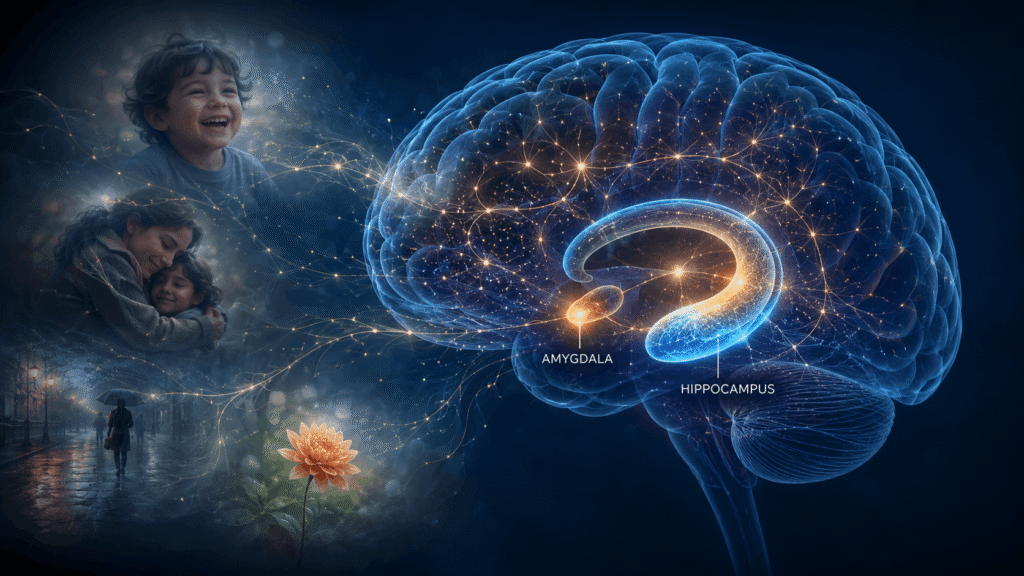
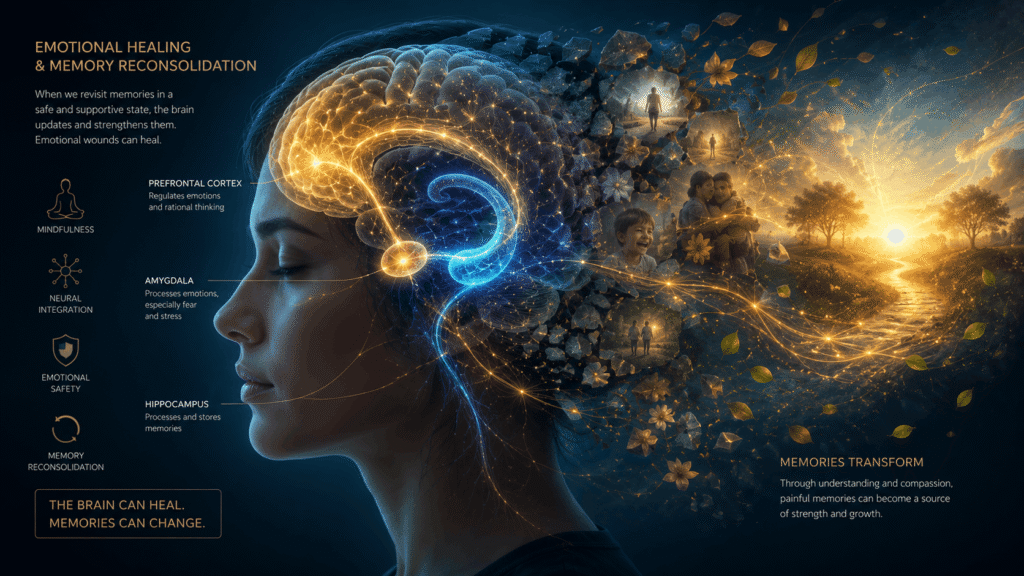
- The amygdala – detects emotional significance, especially fear and threat.
- The hippocampus – organizes events into coherent memories with context.
- The prefrontal cortex – evaluates experiences, regulates emotions, and helps create perspective.
- The insula – processes internal body sensations connected to emotional experiences.
Think of it like a team rather than individual departments.
When something emotionally significant happens, these regions communicate almost instantly.
If the experience feels meaningful or threatening, the brain assigns it a higher priority.
That’s why emotionally charged memories are often remembered more clearly than neutral ones.
Why Strong Emotions Create Stronger Memories
Emotion acts like a highlighter for your brain.
During emotionally intense experiences, your body releases stress hormones such as adrenaline and cortisol.
These chemicals signal:
“Pay attention. This matters.”
As a result, the amygdala strengthens communication with the hippocampus, making the event easier to store and later retrieve.
This process evolved for survival.
Remembering dangerous situations helped our ancestors avoid future threats.
Today, however, the brain doesn’t always distinguish between physical danger and emotional pain.
A humiliating presentation.
A painful breakup.
Repeated criticism.
Childhood unpredictability.
All can become deeply encoded emotional memories because the brain interprets them as important for future survival.
Why Emotional Memories Feel Like They’re Happening Again
One of the most fascinating aspects of emotional memory is that recalling an experience doesn’t simply replay information.
It partially recreates it.
When emotional memories are activated, your brain can trigger many of the same neural networks that were active during the original event.
How Emotional Memories Are Stored in the Brain?
Your body may respond with:
- Increased heart rate
- Muscle tension
- Anxiety
- Tears
- Emotional numbness
- A desire to escape
This is why someone can intellectually know they’re safe while their nervous system still reacts as though danger is present.
The emotional memory isn’t just remembered.
It’s re-experienced.
Emotional Memories Live in the Brain and the Body
You’ve probably heard the phrase:
“The body keeps the score.”
While memories themselves aren’t literally stored inside muscles, emotional experiences become associated with patterns throughout the nervous system.
Your brain learns to predict what comes next.
Over time, your body may automatically respond before conscious thought catches up.
For example:
A raised voice may trigger anxiety.
Silence may feel unsafe.
Success might unexpectedly create discomfort if past achievement was followed by criticism or rejection.
These responses aren’t signs of weakness.
They’re learned survival patterns built from repeated emotional experiences.
This explains why mindset work alone sometimes feels incomplete.
Understanding your thoughts is valuable.
Helping your nervous system experience safety is equally important.
Ready to Understand Your Patterns More Deeply?
If you’re exploring emotional healing, subconscious identity, or nervous system regulation, start paying attention to recurring emotional triggers rather than judging them.
Curiosity creates awareness.
Awareness creates choice.
And choice is where lasting transformation begins.
Can Emotional Memories Change?
Yes.
This is one of the most hopeful discoveries in modern neuroscience.
While you can’t erase your past, emotional memories aren’t permanently fixed.
Every time a memory is recalled, it briefly enters a flexible state called memory reconsolidation.
During this window, new emotional information can become attached to the original memory.
This doesn’t rewrite history.
Instead, it changes how your brain predicts future experiences.
Over time, the emotional charge surrounding certain memories can lessen.
This is why evidence-based approaches like trauma-informed therapy, mindfulness, somatic practices, and cognitive interventions can be so effective.
Healing isn’t forgetting.
It’s updating.
How Emotional Memories Shape Identity
Emotional memories don’t just influence feelings.
They influence beliefs.
Repeated experiences become unconscious conclusions such as:
- I’m not safe.
- I have to work harder to be loved.
- People always leave.
- Success creates pressure.
- Rest isn’t allowed.
Eventually, these beliefs begin shaping decisions without conscious awareness.
You might avoid opportunities.
Stay small.
Overwork.
People-please.
Or sabotage success—not because you lack motivation, but because your emotional memory system is trying to protect you from predicted pain.
Recognizing these patterns is the first step toward changing them.
Supporting Healthier Emotional Memory Processing
Although everyone’s healing journey is unique, research suggests several practices may support healthier emotional processing:
- Mindfulness meditation
- Adequate sleep (critical for memory consolidation)
- Regular physical movement
- Breathwork and relaxation practices
- Safe, supportive relationships
- Trauma-informed psychotherapy when appropriate
- Journaling emotional experiences
- Self-compassion practices
These approaches help strengthen communication between emotional and regulatory brain regions while supporting nervous system flexibility.
Small, consistent practices often create more sustainable change than dramatic breakthroughs.
Frequently Asked Questions
What part of the brain stores emotional memories?
Emotional memories involve multiple brain regions, particularly the amygdala, hippocampus, prefrontal cortex, and interconnected neural networks. Memory storage is distributed rather than located in one single area.
Why are emotional memories so vivid?
Emotion activates stress hormones and the amygdala, strengthening memory formation. Experiences with strong emotional significance are therefore more likely to be remembered.
Can traumatic memories be erased?
Current evidence suggests traumatic memories generally cannot be erased, but their emotional intensity and impact can often be reduced through evidence-based therapeutic approaches and memory reconsolidation processes.
Why do emotional triggers happen automatically?
The brain continuously predicts future events based on past experiences. Emotional triggers often reflect learned survival responses that occur before conscious thinking has time to evaluate the situation.
Does the body actually store trauma?
Trauma isn’t literally stored inside muscles or organs. Rather, the brain and nervous system develop learned physiological responses that can make emotional memories feel physical.
Final Thoughts
Understanding how emotional memories are stored in the brain changes the conversation from “What’s wrong with me?” to “What has my brain learned to protect me from?”
That’s a powerful shift.
Your emotional reactions aren’t random.
They’re often intelligent adaptations created by a brain trying to keep you safe based on previous experiences.
The encouraging part is that your brain remains capable of learning throughout your life.
Through supportive relationships, intentional practices, evidence-based therapies, and repeated experiences of safety, emotional memories can become less overwhelming and more integrated.
You don’t have to erase your past to build a different future.
You simply have to give your brain enough new experiences to believe that a different future is possible.
Read More:
How to Shift From Scarcity to Abundance Daily (Without Forcing Positive Thinking)
The Neuroscience of Deep Focus and Flow State: Why Your Brain Craves Undistracted Work
How the Brain Learns New Skills Faster (And Why Most People Learn the Hard Way)
Why Your Attention Span Is Shrinking: The Surprising Brain Science Behind Constant Distraction
Why Motivation Fails and Habits Win: The Real Secret to Sustainable Success
Breaking Habits Using Brain Science (Not Willpower)
How the Brain Builds Habits Automatically: The Hidden Neuroscience Behind Everyday Behavior